
A buyer is ready to move forward, but the price of the equipment, vehicle, or business asset puts the purchase out of reach. That is where vendor financing qualifications matter. A well-built financing program can turn a stalled conversation into a completed sale, but only when the vendor, the buyer, and the transaction fit the lender’s guidelines.
For dealers, manufacturers, distributors, and service providers, the goal is not to approve every applicant at any cost. The goal is to offer realistic payment options that help qualified customers buy while protecting margins, preserving cash flow, and avoiding surprises at closing. Understanding what lenders review lets your sales team set expectations early and submit cleaner applications.
What Are Vendor Financing Qualifications?
Vendor financing is an arrangement in which a dealer or vendor offers customers access to financing through a lending or leasing partner. The customer makes payments over time, while the vendor receives payment for the sale according to the approved funding structure.
Qualifications are not limited to the buyer’s credit score. Lenders commonly evaluate three areas: the business applying for financing, the asset or service being financed, and the vendor relationship itself. A strong application is one where those three pieces make sense together.
For example, a contractor buying a revenue-producing machine may fit a different credit profile than a restaurant financing a major kitchen buildout. Likewise, a late-model truck with a clear resale market may be easier to finance than highly specialized equipment with limited secondary-market value. The right program depends on the full deal, not one number on a credit report.
Vendor Financing Qualifications Lenders Review
The buyer’s time in business and operating history
Established operating history gives lenders evidence that the business can manage recurring obligations. Many conventional programs prefer at least two years in business, although alternative financing sources may consider shorter operating histories when revenue, bank activity, equipment value, or guarantor strength support the request.
Time in business is not a pass-or-fail rule by itself. A company with several years of operation but declining revenue can be a tougher file than a newer company with consistent deposits, profitable contracts, and a clear reason for the purchase. Lenders want to see that the financed asset has a practical place in the business plan.
Business and personal credit profile
Credit remains a major part of vendor financing qualifications, especially for unsecured structures or transactions with little collateral value. Lenders review business credit when available, but personal credit often matters because an owner guarantee may be required.
A strong profile can lead to lower payments, longer terms, and more flexibility on down payment. Imperfect credit does not automatically end the conversation. It may mean a higher payment, a larger upfront contribution, a shorter term, or a program that puts more weight on revenue and equipment collateral.
The key is to avoid promising a specific rate before a lender has reviewed the file. A payment range is more credible, and it gives the customer room to compare options based on total cost, term length, ownership goals, and cash flow.
Revenue, bank activity, and repayment capacity
Revenue tells a lender whether the buyer can reasonably absorb the proposed payment. Bank statements may show deposit consistency, average balances, overdrafts, negative days, existing debt withdrawals, and seasonality. Financial statements and tax returns can provide a deeper look for larger requests.
From an owner’s perspective, the question should be simple: will this asset generate or protect enough cash flow to justify the payment? A machine that reduces subcontracting costs, a truck that expands capacity, or software that improves billing cycles may support a compelling financing case. A purchase without a measurable business purpose is harder to underwrite.
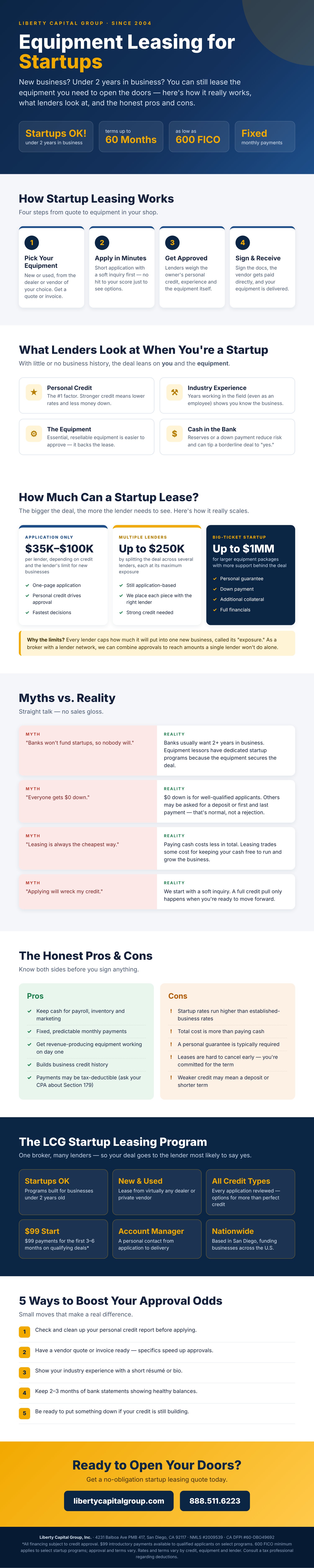 Free InfographicEquipment Leasing for StartupsHow it works, what lenders look at, myths & honest pros and cons.Click to View →
Be prepared for lenders to look at debt service, not just gross revenue. A business can have healthy sales and still be overextended if it has multiple daily or weekly obligations. Sometimes the better recommendation is to refinance expensive debt, extend the term, or structure the transaction with a down payment instead of forcing a payment that strains operations.
The asset, invoice, and transaction details
The asset itself can strengthen an approval. Lenders generally favor equipment, vehicles, and assets with identifiable value, serial numbers, clear ownership, and a reasonable resale market. New and used assets may both qualify, but age, condition, remaining useful life, and vendor documentation affect available terms.
A complete invoice should clearly identify the item being purchased, purchase price, taxes, delivery costs, and any installation or soft costs. If a transaction includes both hard equipment and services, lenders may finance only certain portions or require a different structure.
This is why vendor paperwork matters. Vague descriptions, changing invoices, and missing serial numbers can delay a closing even when the customer is otherwise qualified. Clean documentation helps the lender verify collateral and release funds faster.
Down payment and skin in the game
Not every vendor financing program requires a down payment. However, an upfront contribution can improve the approval odds, especially when credit is challenged, the equipment is older, or the financing request is large relative to the buyer’s revenue.
A down payment lowers the lender’s exposure and may reduce the monthly payment. It can also show commitment from the customer. That said, preserving operating cash is often the reason a buyer seeks financing in the first place. The best structure balances lender requirements with the business’s need to keep working capital available for payroll, inventory, fuel, and growth.
Industry and use of funds
Industry experience, licensing, contracts, and intended use can all affect underwriting. Some assets have a clear income-producing role, while others are more difficult to value or use as collateral. Specialized industries may also face different lender appetites because of regulatory requirements, customer concentration, or volatility.
A vendor should be ready to explain how the asset will be used and why the buyer needs it now. That explanation does not need to be complicated. A concise description of the operational need, expected revenue impact, and delivery timeline can make a deal easier for an underwriter to understand.
How Vendors Can Improve Approval Rates
The fastest way to lose momentum is to submit an application with incomplete information and then ask the buyer for documents one at a time. A better process starts before the application is sent.
Train the sales team to ask a few practical questions early: How long has the business operated? What is the estimated monthly revenue? Is the applicant comfortable providing a personal guarantee if required? Is there a down payment available? What asset is being purchased, and is the invoice complete?
For larger or more complex transactions, gather supporting documentation upfront. The exact requirements vary, but a clean package often includes:
- A completed credit application with correct legal business information
- Recent business bank statements showing operating activity
- A detailed invoice or purchase order
- Equipment specifications, serial numbers, and condition details when applicable
- Financial statements or tax returns for larger requests
It also helps to offer more than one financing path. A lease may create lower monthly payments and preserve bank capacity. An equipment loan may suit a buyer focused on eventual ownership. A shorter term may cost more each month but reduce total financing expense. There is no single best structure for every customer.
Set Buyer Expectations Before Closing
Vendor financing works best when the sales conversation stays transparent. Tell buyers that approval, term, and payment are based on lender review. Avoid framing financing as a simple add-on after the sale is complete. Instead, introduce payment options early, when the customer is still evaluating affordability.
Be direct about potential conditions. A lender may request a larger down payment, a guarantor, proof of insurance, additional bank statements, or clarification on the equipment. These are normal parts of underwriting, not necessarily signs the deal will fail.
Speed matters, but accurate expectations matter more. A fast initial approval can still be delayed by missing documents, title issues, delivery problems, or a mismatch between the approved transaction and the final invoice. Keeping the vendor, customer, and funding advisor aligned protects the customer experience and the sale.
Build a Financing Program Around the Deals You Actually Sell
The right vendor financing program should reflect your average transaction size, customer profile, asset type, sales cycle, and margin needs. A vendor selling $20,000 equipment to established local businesses may need a different lending mix than a dealer selling high-value commercial vehicles or specialized industrial assets.
Liberty Capital Group helps vendors evaluate multiple lending and leasing paths so financing supports the sale instead of becoming another obstacle. The focus should always be on a payment structure your customer can sustain and a process your team can use with confidence.
If you are evaluating vendor financing qualifications for an upcoming sale, prepare the core business and asset details early, compare realistic options, and request a payment quote before the customer loses momentum.