A failed lift, a backed-up service bay, or a parts invoice that arrives before insurance proceeds can turn a profitable month into a cash-flow problem. The top funding solutions for auto shops are not interchangeable. The right one depends on whether you need to buy a revenue-producing asset, bridge a short-term gap, expand capacity, or protect operating cash while business is strong.
A bank term loan can work well for an established repair business with time to wait and strong financials. But many shop owners need an answer sooner, need a structure built around the asset being purchased, or want to keep a cash reserve available for payroll, inventory, and unexpected repairs. That is where a broader financing strategy matters.
Top Funding Solutions for Auto Shops by Need
The most effective financing decision starts with the use of funds, not just the amount requested. Matching the term of financing to the useful life of what you are buying is a practical CFO-level rule. Financing a diagnostic platform over time can make sense. Using a long-term loan for a two-week payroll gap usually does not.
Equipment financing for revenue-producing tools
Equipment financing is often the strongest fit when your shop needs lifts, alignment systems, tire machines, scan tools, compressors, paint booths, ADAS calibration equipment, or other major shop assets. The equipment typically supports the transaction, which can make approval more accessible than a purely unsecured request.
The key advantage is preserving cash. Instead of tying up $40,000 or $100,000 in equipment on day one, the shop can spread the cost over a defined term while the asset helps generate revenue. Monthly payments should be evaluated against the additional billed labor, throughput, or service capability the equipment creates.
Terms, down payments, rates, and end-of-term options vary. A newer, easily valued asset may qualify for more favorable terms than specialized or used equipment. Ask whether the structure includes a fixed purchase option, a fair market value purchase option, or an equipment lease. The answer affects the payment, ownership path, accounting treatment, and long-term cost.
Equipment leasing when flexibility matters
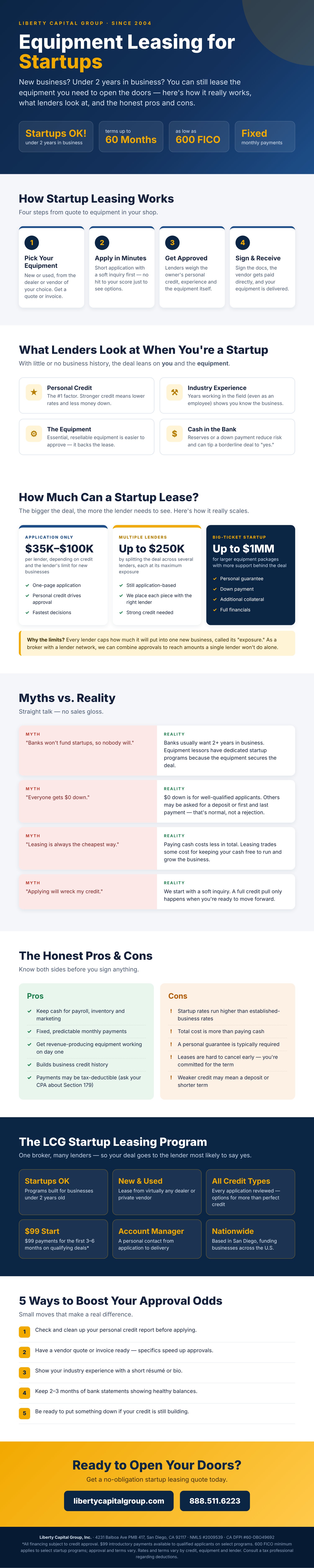
Leasing can be a smart choice for shops that want lower upfront costs, predictable payments, or a path to upgrade equipment as technology changes. This is especially relevant for diagnostic and calibration technology, where staying current can protect your shop from losing high-value work to a dealership or larger competitor.
A lease is not automatically cheaper than buying, and a lower monthly payment does not always mean a lower total cost. Still, it may be the better cash-flow decision when working capital is more valuable inside the business than tied up in equipment. Review end-of-term obligations closely and have your tax professional assess the available depreciation and deduction treatment for your situation.
Working capital and business lines of credit
Auto repair is a working-capital business. You may pay technicians weekly, purchase parts daily, carry tire inventory, and wait for fleet accounts, warranty administrators, or commercial customers to pay. A line of credit or other working capital facility can cover the timing difference without forcing you to delay repairs or drain your operating account.
Equipment Dealers & VendorsOffer Financing On the SpotFree Vendor Package: program guide, credit guidelines & customer credit app. Close more sales, earn referral fees.Download Free →A revolving line is particularly useful for recurring needs: stocking fast-moving parts, managing seasonal slowdowns, covering deductible expenses after a major shop repair, or taking advantage of supplier discounts. You draw what you need, repay it, and use it again if the facility remains available.
The important distinction is discipline. A line used to finance persistent operating losses can create pressure fast. A line used to bridge predictable receivables or support a clearly profitable service opportunity can give an owner room to operate with confidence.
Term loans for expansion and larger projects
A business term loan can fit an expansion with a defined budget and expected payoff. Examples include adding service bays, renovating a waiting area, opening a second location, buying inventory in bulk, or acquiring an established shop’s assets. Fixed payments can make planning easier when the project has a clear timeline and revenue forecast.
Before accepting an offer, build a conservative payment model. Account for the new debt payment, insurance, utilities, labor, marketing, permits, and the ramp-up period before new bays reach full utilization. A six-bay expansion may look attractive on paper, but the right question is whether your current technician pipeline, car count, and local demand can support it.
Merchant cash advances for urgent, short-duration needs
A merchant cash advance can provide fast capital based largely on card sales or business revenue. For an auto shop facing a short-term opportunity or urgent expense, speed may be the deciding factor. It can help when a lift goes down unexpectedly, a key inventory purchase cannot wait, or a repair opportunity has a clear, near-term return.
The trade-off is cost and repayment pressure. Unlike a traditional loan, repayment is often structured through daily or weekly remittances. That can strain cash flow during slower periods. This option should be evaluated carefully, with full attention to the total payback amount, payment frequency, and whether the expected benefit exceeds the financing cost.
Invoice factoring for commercial and fleet receivables
Shops that service municipal vehicles, fleet accounts, dealerships, or commercial clients may have money tied up in invoices with 30-, 60-, or 90-day payment cycles. Invoice factoring can turn eligible receivables into near-term cash instead of waiting for customers to pay.
This can be more practical than using high-cost short-term financing to cover payroll or parts while accounts receivable ages. The quality of your customers, invoice terms, concentration of receivables, and documentation all matter. Factoring is best viewed as a cash-flow tool, not a substitute for fixing weak collections policies.
How to Choose the Right Auto Shop Funding Structure
Start by separating capital expenditures from operating expenses. A new alignment rack that will produce income for years belongs in an equipment-focused structure. Tires and routine parts may belong on a revolving facility. A renovation or acquisition may call for a term loan with a payment schedule that reflects the project’s longer return horizon.
Next, measure payment capacity using real shop numbers, not optimism. Review average repair order, billed hours, technician productivity, gross margin by service line, monthly fixed expenses, and receivable aging. If a payment only works in your busiest month, the structure is too aggressive.
Also consider the financing terms beyond the payment. Prepayment terms, personal guarantees, liens, documentation requirements, funding speed, and end-of-term purchase options can all change the value of an offer. The cheapest-looking payment can become expensive if it restricts future borrowing or carries an unfavorable payoff requirement.
A qualified funding advisor can help compare these variables across multiple lenders rather than pushing every need into the same product. Liberty Capital Group works with business owners to identify a realistic financing path based on the shop’s revenue, equipment, credit profile, and timeline.
Prepare Before You Apply
A well-prepared application usually moves faster and gives lenders a clearer view of your business. Have recent business bank statements, a photo ID, basic business details, and a quote or invoice for equipment ready. For larger requests, lenders may also ask for financial statements, tax returns, debt schedules, and accounts receivable information.
Be direct about the purpose of funds. “Working capital” is broad. “$35,000 to purchase an alignment system that adds two billed jobs per day” is specific, measurable, and easier to evaluate. The same principle applies to an expansion request: show the cost, timeline, current capacity, and expected revenue impact.
The best financing should help your shop serve more vehicles, protect cash flow, or capture profitable work without creating a payment burden that slows the business down. Request a payment quote and compare your options before the next equipment failure, inventory purchase, or growth opportunity forces a rushed decision.